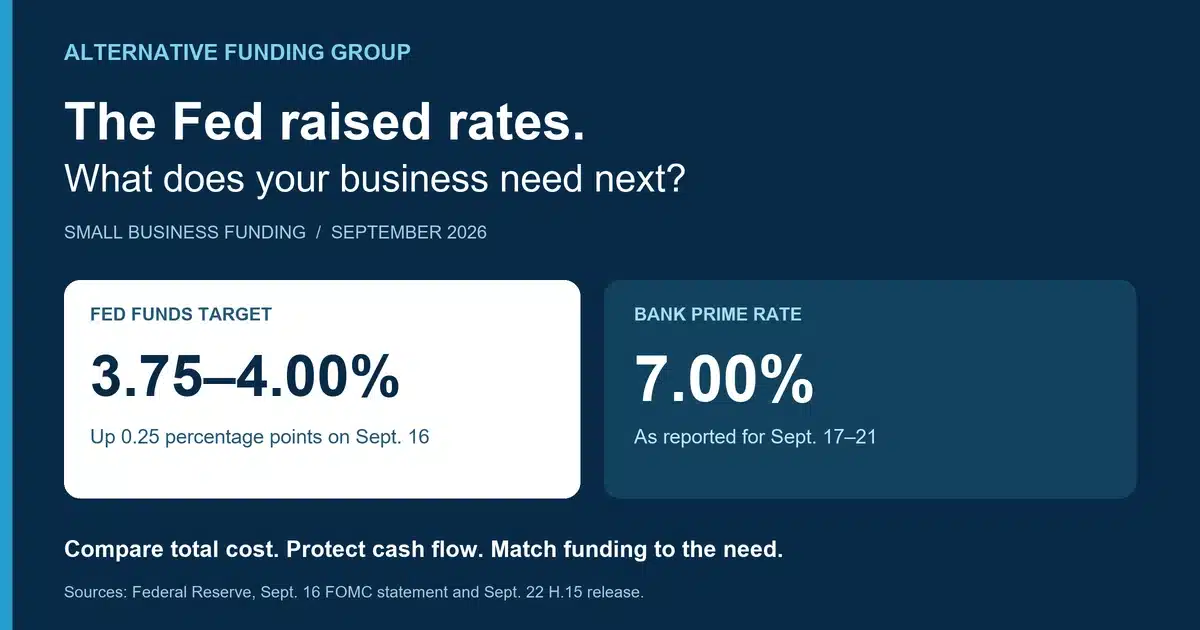
The takeaway: September’s Federal Reserve rate hike makes this a good time to check the cost and timing of your business funding. Variable-rate borrowing may become more expensive when your contract resets; an existing fixed-rate loan generally keeps its agreed rate. Before choosing alternative business funding, compare total cost, payment frequency and the cash your business can reliably generate.
What changed in September 2026?
On September 16, the Federal Reserve raised its target range for the federal funds rate by 25 basis points, or 0.25 percentage point, to 3.75%–4.00%. The Fed cited elevated inflation in its September policy statement.
That target is different from the rate a business pays. The Fed’s September 22 H.15 release reports the bank prime rate at 7.00% beginning September 17, up from 6.75%. Prime is one benchmark banks use to price short-term business loans. Your actual rate depends on your agreement, including its benchmark, lender margin, adjustment dates and any rate floor or cap.
For an owner planning payroll, inventory or a busy fourth quarter, the useful question is specific: which existing obligations can change, and how much room remains after operating expenses?
How much could a quarter-point increase cost?
If the rate on a $100,000 outstanding balance rises by 0.25 percentage point, a simple interest illustration is:
$100,000 × 0.0025 = $250 more interest per year
That is approximately $20.83 per month.
This calculation assumes the balance and the higher rate remain unchanged for a full year. It excludes fees, compounding and principal payments, and is an illustration of added interest—not a payment quote. Your lender’s calculation and reset schedule determine the actual change.
Review the agreement before changing your budget. The SBA’s 7(a) guidance, for example, explains that fixed-rate loan payments stay steady, while a variable-rate lender may adjust the payment when the interest rate changes. It also identifies working capital and equipment among permitted 7(a) uses.
Which funding structure fits your cash flow?
Compare the use of the money with the way it must be returned. These four categories serve different needs; product terms and eligibility vary.
| Option | Potential use | What to examine |
|---|---|---|
| Variable-rate business line of credit | Recurring gaps between paying suppliers and collecting revenue. | Benchmark, margin, reset dates, draw fees and required payments at a higher rate. |
| Fixed-rate term loan | A defined investment with a planned repayment period. | Net proceeds, scheduled payments, total interest and fees, and early-payoff terms. |
| Equipment or invoice financing | A specific asset purchase or cash tied up in customer invoices. | Asset security, invoice eligibility, fees, customer-payment delays and any recourse obligations. |
| Merchant cash advance | A near-term need supported by expected future business receipts. | Purchased receivables, total remittance amount, collection frequency and the contract’s reconciliation process. |
A merchant cash advance is typically structured as a purchase of future receivables. A quoted factor rate is not an annual percentage rate (APR); it does not, by itself, express cost over a year. Daily or weekly remittances can reduce cash available between customer payments. Read the agreement’s treatment of changing sales and reconciliation rather than assuming collections automatically adjust.
What should you check before funding your next 13 weeks?
Build a weekly forecast from actual expected deposits and scheduled outflows. A profitable month can still contain a week when payroll arrives before customer payments.
- Start with usable cash. Record the opening bank balance and identify money already committed to taxes, payroll or other obligations.
- Schedule realistic receipts. Use collection dates, not invoice dates. Separate confirmed orders from hoped-for sales and flag customers that commonly pay late.
- Map every outflow. Include suppliers, rent, payroll, taxes, loan payments and existing funding remittances. Place daily or weekly collections in the correct week.
- Recheck variable-rate contracts. Ask when the next reset occurs and obtain the new payment amount. Update the forecast using the agreement’s actual terms.
- Test a slower-sales case. Model a customer paying two weeks late or sales coming in below your base forecast. Note the lowest projected cash balance.
- Match the request to the gap. Define the amount, intended use, expected benefit and date the investment starts producing cash. Compare each offer within the same forecast.
A retailer buying seasonal inventory should consider sell-through time and markdown risk. A contractor waiting on an approved invoice should allow for collection delays. A restaurant replacing equipment should compare the payment schedule with expected operating cash, not just the equipment’s purchase price.
If the forecast shows an ongoing shortfall even without new financing, review pricing, margins, collections and expenses first. Funding can bridge a timing gap; it also adds a claim on future cash.
How should you compare alternative business funding offers?
Ask each provider for the same information in writing: cash deposited after fees, total repayment or purchased-receivables amount, payment or remittance frequency, expected duration, early-payoff terms, and any security interests or personal guarantees.
When comparing alternative business financing, put those cash movements into your forecast. A smaller daily collection and a larger monthly payment affect different weeks. Neither can be judged from the headline number alone.
If you are researching merchant cash advance direct lenders, confirm which company supplies the funds, which company services the agreement and who handles reconciliation requests. Then read the full contract before accepting an offer.
Explore our working capital funding options and merchant cash advance overview to prepare for that conversation.
Frequently asked questions
No. The effect depends on your agreement. A variable-rate loan may reset when its benchmark changes. An existing fixed-rate loan generally keeps its agreed rate. Check the contract and confirm the next payment with your provider.
No. The federal funds target range is a monetary-policy benchmark. Prime is a separate bank lending benchmark. Your contract determines your business’s rate, including any lender margin, floor, cap and reset schedule.
No. A factor rate does not express an annualized borrowing cost. To understand the cash-flow impact, review the net funds received, total remittance amount, collection frequency, expected duration and all fees.
Prepare recent bank statements, an up-to-date list of existing obligations, the purpose and amount of funding, and a 13-week cash-flow forecast. A provider may request additional documents based on the product and your business.
Put your funding options beside your cash-flow plan
Know how much you need, what it will fund and what your business can support. Share those details with Alternative Funding Group to discuss available options and their terms.
Sources
- Federal Reserve: September 16, 2026 FOMC statement
- Federal Reserve: H.15 interest rates, September 22, 2026 release
- U.S. Small Business Administration: 7(a) loans
Market information checked September 23, 2026. Rates and individual funding terms can change.

